
The Ultimate Guide to Machine Moving Skates, Dollies & Air Skates
Relocating a CNC machine, a generator, or an entire production line without a crane or forklift sounds risky — but it’s exactly what machine moving skates, dollies, and air skates are built for. This guide breaks down the differences, the load classes, and how to choose the right one for your factory or warehouse.
Moving heavy machinery is one of the highest-risk jobs on a factory floor. A single miscalculated lift or an undersized skate can damage the equipment, the floor, or worse — injure the operator. Yet many facilities in Malaysia still try to “make do” with makeshift rollers or borrowed pipes instead of proper rated equipment.
This guide is written for engineers, maintenance managers, and warehouse supervisors who need to relocate heavy equipment safely — whether it’s a one-off machine relocation or a full production line reshuffle.
What Are Machine Moving Skates? (And How Are They Different from Dollies, Rollers & Air Skates)
The terms “skates,” “dollies,” “rollers,” and “air skates” get used interchangeably online, but they’re not the same tool. Here’s the practical distinction:
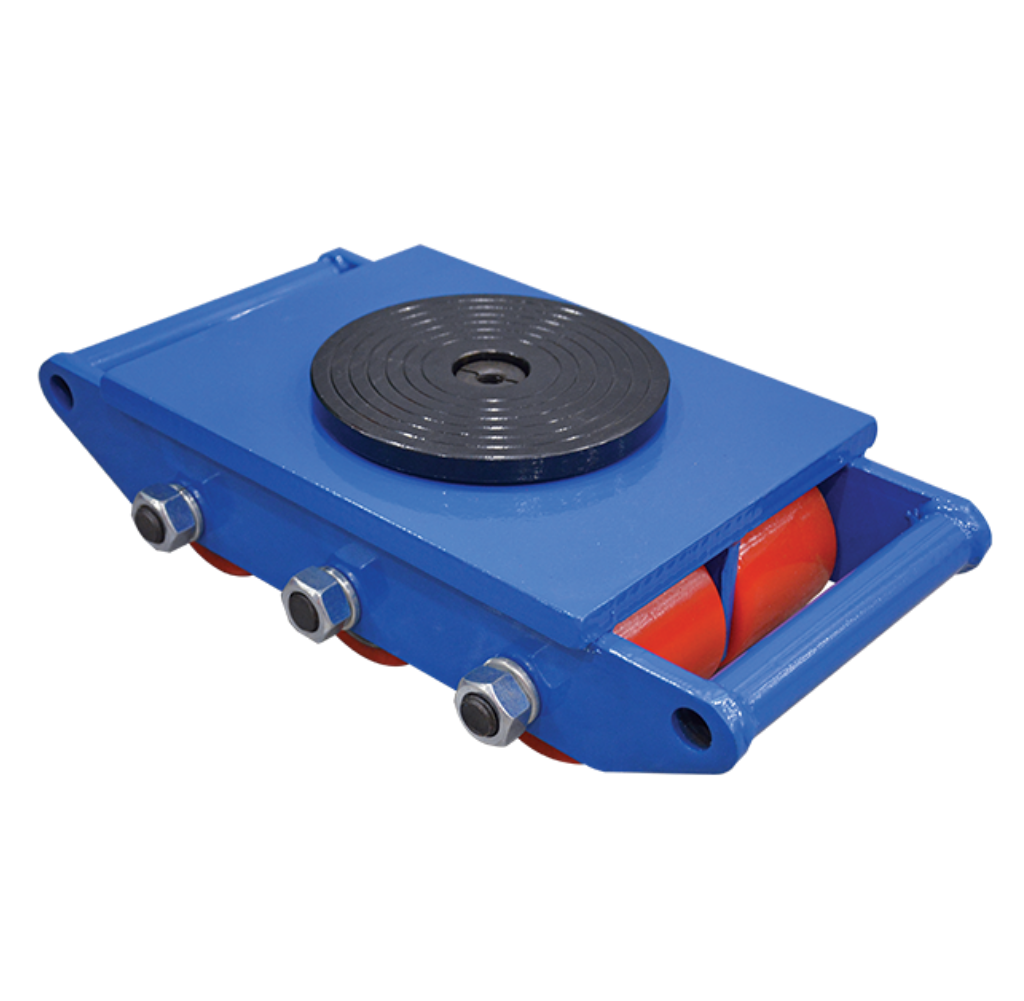
- Machine moving skates — Low-profile steel platforms mounted on heavy-duty castors, designed to be jacked or levered under a machine’s base. They’re the standard choice for moving heavy, awkwardly shaped equipment short distances across a solid floor.
- Machinery dolly — A simpler platform on wheels or rollers, typically used for lighter loads or as a support unit alongside skates, rather than for taking the full weight of very heavy machines.
- Machine moving rollers — Cylindrical rollers placed under a load to let it roll forward in a straight line. Cheap and simple, but they offer no steering and need constant repositioning as the load moves.
- Air skates — Use a thin cushion of compressed air to let extremely heavy loads glide almost frictionlessly across a flat, sealed floor. Powerful, but they need an air compressor and a very specific floor condition to work.
In short: if you need to precisely steer a heavy machine through a tight factory aisle, skates are usually the right tool. If you’re moving a very heavy load in a straight line on a smooth floor and have compressed air on hand, air skates are worth considering. Rollers and basic dollies suit lighter, simpler jobs.
Load Classes — Matching the Skate to the Machine
The single most common mistake in machinery relocation is picking a skate rated for the wrong weight class. Before choosing, weigh (or estimate from the equipment nameplate) the actual load, then work with a margin of safety — never load a skate to its absolute maximum rated capacity.
- Light duty (under 1 tonne): Small compressors, light packaging machines, office equipment relocations.
- Medium duty (1–5 tonnes): Standard CNC machines, injection moulding machines, mid-size generators.
- Heavy duty (5–15 tonnes): Large presses, transformers, heavy generators, industrial ovens.
- Super heavy duty (15 tonnes+): This is where air skates or a multi-skate rigging setup (several skates working together under one machine) typically come in, often combined with a hydraulic toe jack to lift the machine before positioning the skates underneath.
If you’re unsure which class your equipment falls into, it’s worth getting a professional assessment rather than guessing — an underrated skate can fail suddenly under load. As a rule of thumb, choose a skate set whose combined rated capacity exceeds your machine’s actual weight by at least 20–30% — this margin accounts for uneven weight distribution, where one skate can momentarily carry more load than the others mid-move.
Where Machine Moving Skates Are Actually Used
- Production line reshuffles — Reconfiguring a factory floor for a new process without shutting down for days.
- Equipment installation & commissioning — Positioning new machinery precisely once it arrives on-site.
- Facility relocation — Moving an entire workshop or production line to a new address.
- Maintenance repositioning — Pulling a machine away from a wall or line for servicing, then putting it back in exactly the same spot.
In all four cases, the appeal of skates over a forklift or crane is the same: they let you move a load through spaces a forklift can’t reach, with far more precision, and often with a smaller crew.
How to Choose the Right Skates for Your Warehouse or Factory
- Confirm the actual load weight — check the equipment nameplate, engineering drawings, or have it weighed. Round up, not down.
- Check your floor condition — skates need a reasonably flat, solid floor. Uneven concrete, expansion joints, or gaps can cause a skate to jam or tip.
- Consider the wheel/castor type — polyurethane castors are quieter and better for finished floors; steel or nylon castors suit rougher industrial floors but can be noisier and harder on flooring. (See our Castor Wheel guide for material comparisons.)
- Plan your steering and turning radius — if the route includes tight corners, choose skates with a swivel or steerable design rather than fixed-direction units.
- Decide if you need a full multi-skate set — most heavy machines need 3–4 skates working together, positioned under different load points, rather than a single skate.
- Factor in the lifting step — you’ll usually need a hydraulic toe jack or bottle jack to lift the machine just enough to slide the skates underneath.
Common Mistakes and Safety Reminders
- Overloading a skate “just this once.” Rated capacity exists for a reason — a skate that fails mid-move can crush feet or drop expensive equipment.
- Skipping the floor check. A crack or uneven joint that looks minor can still catch a wheel and tip the load.
- Using mismatched skates under one machine. All skates supporting the same load should be rated for a similar capacity and ideally be the same type — mixing worn and new units under one machine is a common cause of uneven load distribution.
- Moving alone. Even with skates doing the heavy lifting, machinery relocation should always be a supervised, multi-person job with clear communication and a planned route.
- Ignoring maintenance. Castors seize up or develop flat spots over time. Inspect skates before every major move, not just when something feels wrong.

Komada Machine Moving Skates — Product Comparison
Komada’s range covers three load tiers, from manually positioned skates up to a fully electric 20-tonne system:
| Model | Rated Capacity | Platform Type | Best For |
|---|---|---|---|
|
6 – 12 Ton |
Circle Platform |
Round-base or compact machinery needing a smaller footprint per skate |
|
|
6 – 12 Ton |
Rectangle, larger platform |
Wider machine bases needing more surface contact and stability |
|
|
20 Ton |
Electric-powered movement |
Very heavy machinery (presses, transformers) where manual pushing isn’t practical |
Beyond load capacity, Komada’s skates also come in two platform configurations depending on how the machine needs to travel:
- Fixed Platform — an extra-wide, non-slip platform built for straight-line, long-haul transport of oversized equipment. Best when the route has no tight turns.
- Swivel Turntable Platform — a heavy-duty rotating turntable that allows a full 360° turn, ideal for navigating corners and precisely positioning machinery in tight factory aisles.
This maps directly back to the load classes and steering guidance covered earlier: for anything above the 12-tonne range, or where a crew would otherwise be pushing a heavy load by hand, the Electric Machine Moving Skate removes the manual effort entirely. For tight, corner-heavy layouts, pair a swivel/steerable skate at the front (as recommended in Komada’s own 3-point configuration guidance) with fixed skates at the back for tracking stability.
Latest Blog
-
Floor Scrubber Machine Buying Guide: How to Size It Right and Calculate the ROI
-
The Ultimate Guide to Machine Moving Skates, Dollies & Air Skates
-
2-Way Pallet Shuttle System: Maximizing Warehouse Storage Density with Minimal Space
-
Pallet Stacker vs Forklift: Maximize Storage impression
-
Equipment Selection Guide in High Density Warehouse
Product Enquiry
Fill out the form below and we will contact you as soon as possible.
Visit Our Showroom
Office: F1, TTF Group – Rawang HQ
Business Hour: Monday to Friday 8:00am – 6:00pm | Saturday: 8:30am – 1:00pm