
Floor Scrubber Machine Buying Guide: How to Size It Right and Calculate the ROI
Before comparing brands or specs, most facilities skip the one step that actually determines which floor scrubber machine they need: sizing it to the space and the labor cost it replaces. This guide walks through the sizing formula, the real ROI math versus manual mopping, and how to decide between a walk-behind and a ride-on model for a Malaysian warehouse or factory floor.
Buying a floor scrubber machine is usually triggered by one of two things: a facility has outgrown manual mopping, or an existing machine is too small (or too big) for the space it’s covering. Either way, the decision usually comes down to two questions that this guide answers directly: how much machine do you actually need, and does it pay for itself?
Walk-Behind vs Ride-On — What Actually Separates Them
- Walk-behind scrubbers — The operator pushes or walks alongside the machine. Lower upfront cost, more maneuverable in tight aisles, and generally suited to facilities under roughly 2,000–3,000 sqm per cleaning shift.
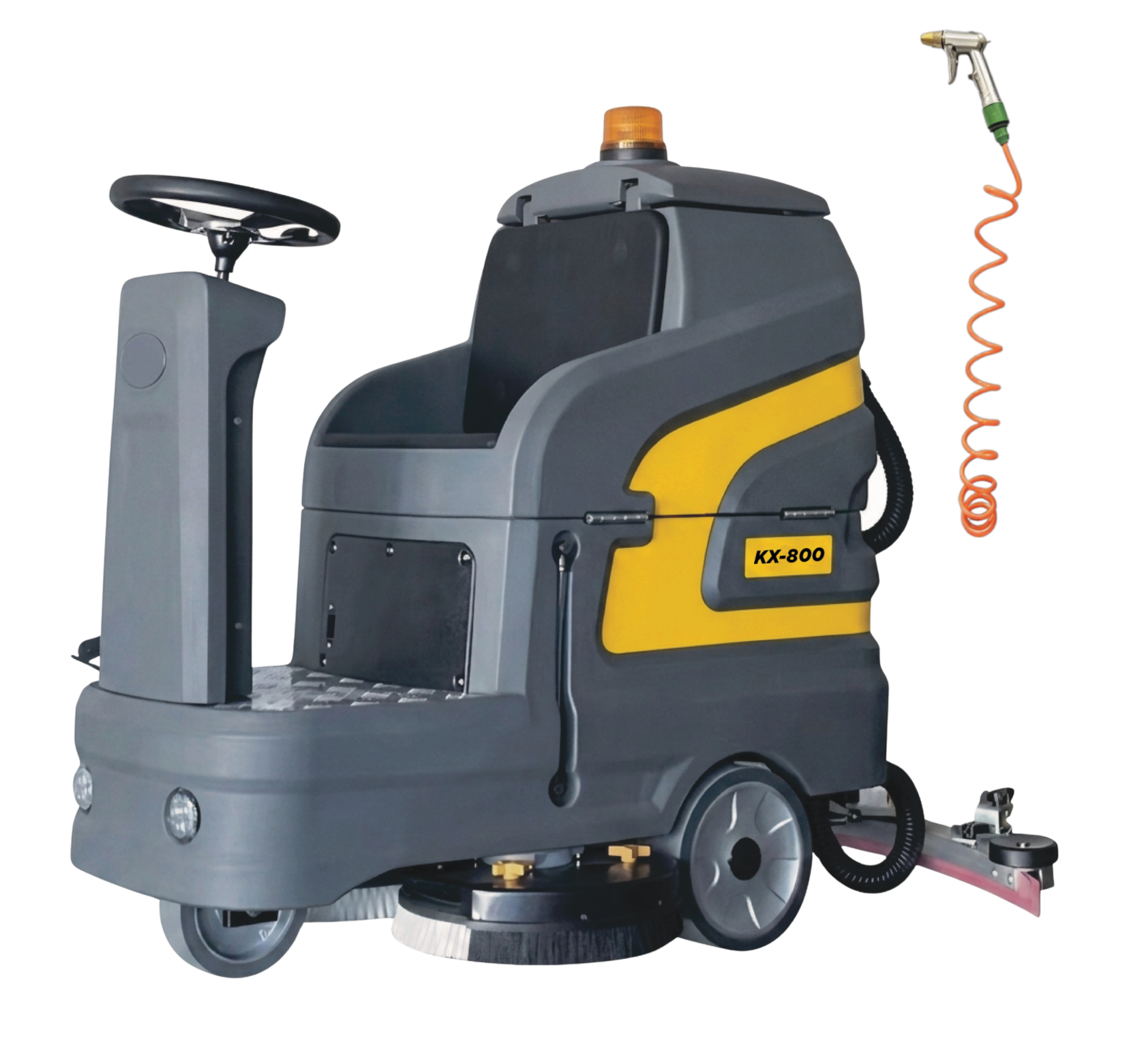
- Ride-on scrubbers — The operator sits or stands on the machine. Higher upfront cost, but covers significantly more floor area per hour, and reduces operator fatigue on large, continuous runs — usually the better choice above roughly 3,000–5,000+ sqm per shift, depending on layout and obstacle density.
The tipping point isn’t really the raw floor area — it’s how much of that area is open, continuous space versus broken up by racking, machinery, or tight corners. A 4,000 sqm warehouse with wide open aisles may still be better served by a ride-on; a 2,500 sqm facility packed with obstacles may still need a walk-behind for maneuverability, even though the area alone would suggest otherwise.
How to Size a Floor Scrubber to Your Facility
Use this simple formula to get a starting estimate before looking at specific models:
Cleaning capacity needed (sqm/hour) = Total floor area ÷ Available cleaning window (hours)
Worked example: A 3,000 sqm warehouse with a 1-hour cleaning window before each shift needs a machine capable of covering roughly 3,000 sqm/hour — which typically points toward a mid-to-large walk-behind or an entry-level ride-on, depending on obstacle density (see above).
Three factors that push the estimate up or down:
- Floor condition — heavily soiled or oily floors (common in manufacturing) need more passes, effectively reducing real coverage speed.
- Obstacle density — racking, columns, and machinery slow a machine down far more than raw square footage suggests.
- Water/solution tank size — a machine may be rated for a certain coverage speed, but if its tank runs dry halfway through the floor, actual daily throughput is lower than the spec sheet implies. Match tank capacity to how far the machine can travel before needing a refill stop.
The ROI Math — Manual Mopping vs Machine Scrubbing
This is the calculation most facilities skip, and it’s usually what actually justifies the purchase to management:
| Manual Mopping | Floor Scrubber Machine | |
|---|---|---|
|
Coverage rate |
~150–250 sqm/hour per worker |
1,500–4,500+ sqm/hour depending on model |
|
Labor required |
1 worker per mopping shift, ongoing |
1 operator, same shift, far larger area covered |
|
Water/chemical usage |
Higher — frequent bucket changes, less controlled dosing |
Lower — controlled solution tank dosing |
|
Cleaning consistency |
Variable, operator-dependent |
Consistent, machine-controlled |
Simplified example: A facility currently paying one worker to mop 2,000 sqm daily (roughly 8–13 hours of manual labor at 150–250 sqm/hour) could cover the same area with a mid-size walk-behind scrubber in under 2 hours — freeing that labor hour capacity for other tasks, or covering a larger area entirely within the same shift.
The exact payback period depends on local labor cost, machine price, and how the freed-up labor hours are redeployed — but for most facilities cleaning 1,500+ sqm regularly, the case for a machine typically becomes clear within the first 6–12 months.
Tank Capacity, Brush Type & Runtime — What the Numbers Actually Mean
- Solution/recovery tank size — determines how long the machine can run before a refill/empty stop. Larger tanks mean fewer interruptions but a heavier, bulkier machine.
- Single disc vs dual brush — single disc brushes are typically better for polishing and lighter soil; dual brush (cylindrical) configurations generally handle heavier debris and uneven or textured floors more effectively. (See our KX-760 Single Disc Scrubber and KX-800 Dual Brush Scrubber for direct comparisons.)
- Battery runtime vs corded/petrol options — battery runtime should be matched to your actual cleaning window, not just the shift length; account for the fact that runtime drops on heavily soiled floors that need multiple passes.
Common Mistakes When Choosing a Floor Scrubber Machine
- Sizing to total floor area instead of the actual cleaning window — a machine that can technically cover your facility in 8 hours is the wrong choice if you only have a 1-hour window before the next shift starts.
- Ignoring obstacle density — a ride-on that can’t maneuver around racking ends up leaving significant areas for manual touch-up anyway, undermining the labor savings that justified the purchase.
- Underestimating tank refill downtime — a machine with a small tank on a large floor may spend more time being refilled than actually cleaning.
- Choosing based on price alone without factoring in coverage rate — a cheaper machine that covers half the area per hour can end up costing more in labor over its lifespan than a pricier, faster model.
Komada Floor Scrubber Range — Which Model Fits Which Facility Size
| Model | Type | Best Suited For |
|---|---|---|
|
Walk-behind |
Smaller facilities, tighter aisles, entry-level budget |
|
|
Walk-behind, single disc |
Lighter soil, polishing-adjacent finishes |
|
|
Walk-behind, dual brush |
Heavier debris, textured/uneven floors |
|
|
Walk-behind, large tank |
Larger facilities needing fewer refill stops |
|
|
Ride-on |
Large, open-plan warehouses with continuous runs |
Quick Reference Checklist Before You Buy
Measured total floor area and actual available cleaning window (not just shift length)
Assessed obstacle density — racking, columns, tight corners
Identified floor condition — light dust vs oily/heavily soiled
Compared tank size against realistic run-time-before-refill needs
Calculated rough labor-hour savings versus current manual mopping cost
Decided walk-behind vs ride-on based on the above — not on floor area alone
Confirmed with Komada which model matches the facility size (see table above)
Latest Blog
-
Floor Scrubber Machine Buying Guide: How to Size It Right and Calculate the ROI
-
The Ultimate Guide to Machine Moving Skates, Dollies & Air Skates
-
2-Way Pallet Shuttle System: Maximizing Warehouse Storage Density with Minimal Space
-
Pallet Stacker vs Forklift: Maximize Storage impression
-
Equipment Selection Guide in High Density Warehouse
Product Enquiry
Fill out the form below and we will contact you as soon as possible.
Visit Our Showroom
Office: F1, TTF Group – Rawang HQ
Business Hour: Monday to Friday 8:00am – 6:00pm | Saturday: 8:30am – 1:00pm